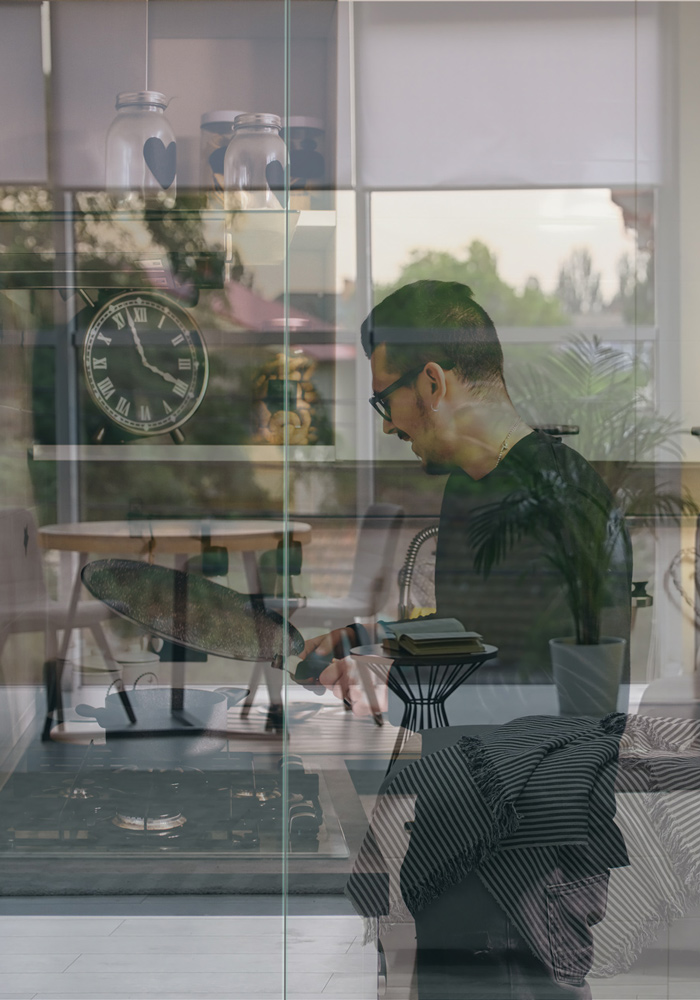
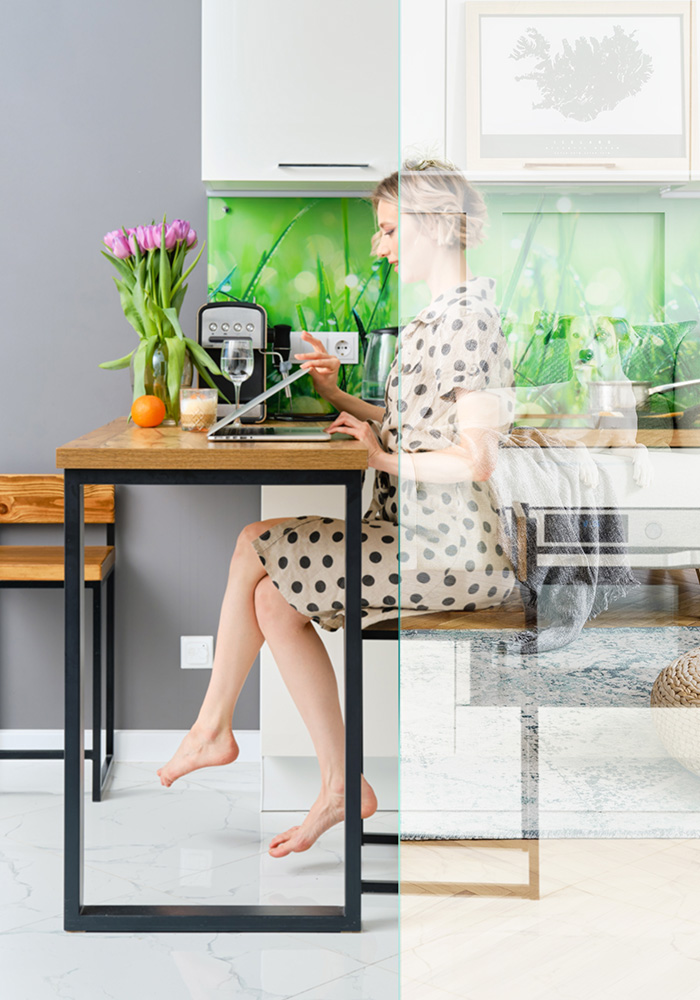
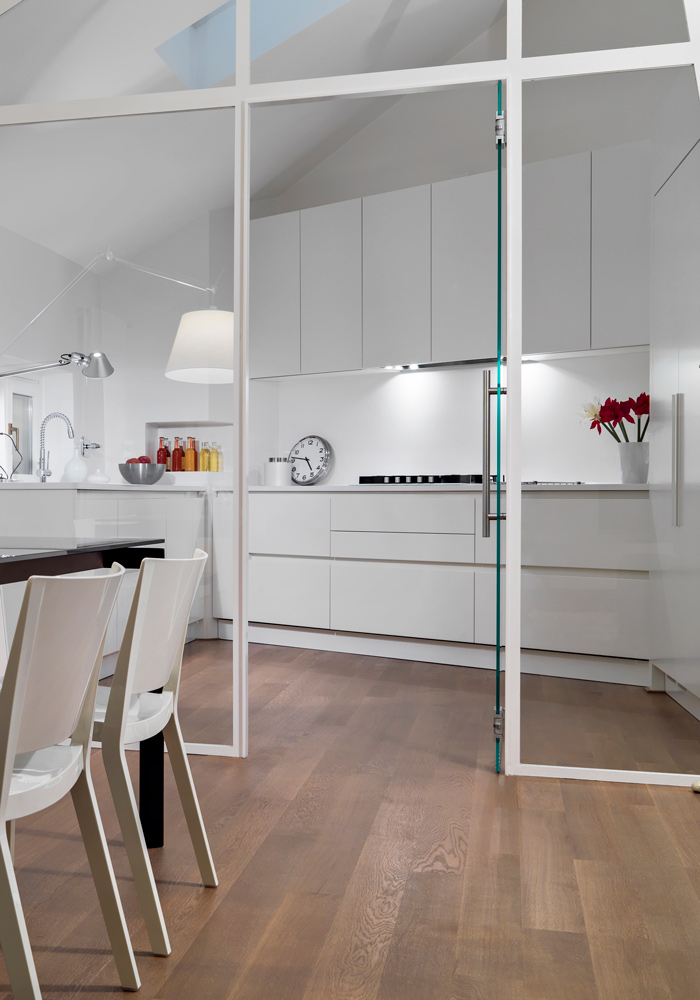
A glass partition lets the kitchen share its light with the room next door, and keeps the cooking to itself.
Open plan gives you the light and the sightlines, and lets the cooking smells travel with them. Put up a solid wall and the smells stop, but so does the daylight. Glass gives you one without costing you the other: the rooms stay separate, the light carries straight through, and you can still see who’s at the table from the hob. Every panel is cut to your opening, and the glass can be clear, frosted where you want less on show, or printed with a design of your choosing.
In a kitchen, floor space is the thing you can't spare. A sliding door takes none of it.
Sliding doors run on a top channel alone, so there’s no arc of floor kept clear for a door to swing into and no track underfoot for crumbs to collect in. That makes them the answer to the openings a hinged door was never going to work in: a narrow galley, a utility off the kitchen, a pantry squeezed in beside the units. Where a hinged door does suit the space, it mounts to the wall as usual, or on hydraulic hinges that let it open from either side.
Framed and gasket-sealed,
so you can't hear the dishwasher from the sofa.
A framed door sits in an aluminium or black profile with a gasket between the glass and the frame, which closes the gap around the edge that smells and noise would otherwise travel through. It’s the option to choose if the kitchen opens onto a living room you’d rather keep free of last night’s cooking, or if the dishwasher tends to run while someone’s watching television next door. The black frame is also what gives you the Crittall look that suits a kitchen-diner, without building anything solid.
What you get with glass doors and partitions
Daylight carried through from one room to the next.
Cooking smells and noise kept on the kitchen side of the glass.
Cut to your opening, in the size, shape and thickness the space calls for.
Clear, frosted, coloured or printed, including designs that match your splashback.
Top-channel sliding for openings with no room to swing a door.
A gasket-sealed frame where the seal actually matters.
Open the kitchen up or close it off, without building work.
Dear customers,
We are closed from 23.12.2025 until 05.01.2026 for Christmas & New Year Break 🧑🎄🎅
We will respond to all the inquiries on our return.
We appreciate your continued support 😊