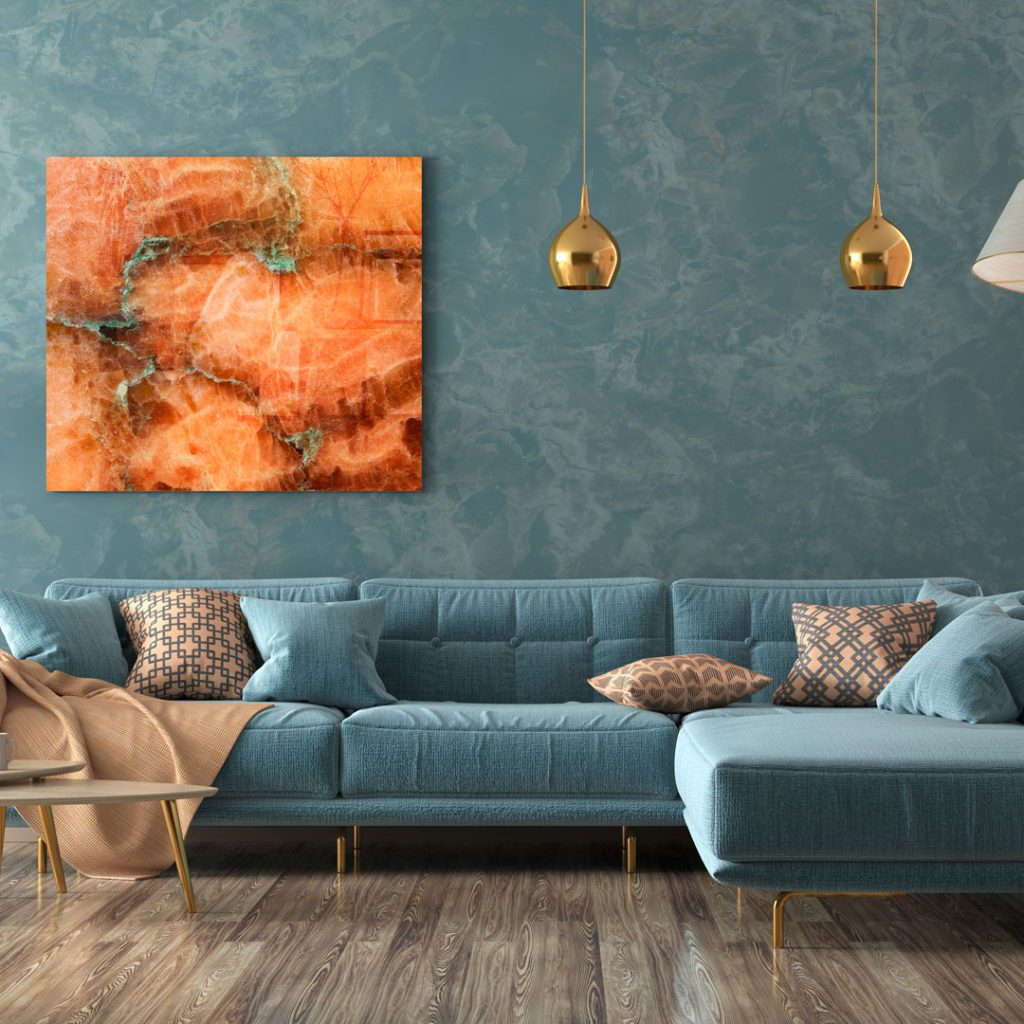
Give a blank office wall something to do. One sheet of toughened glass carries an image worth looking at, or a week's worth of notes.
Either way it’s cut to your wall rather than ordered in a standard size, and the flat, frameless finish sits well against exposed brick, glass partitions and steel framing, the kind of finishes most modern offices are already built with. That’s what makes it read as part of the space rather than something bolted on afterwards, whether it ends up as artwork in reception or a working surface in a project room.
A printed panel in reception is the first thing a client sees, and it works before anyone has said a word.
The image is printed directly onto toughened glass or laminated behind it, so the colours stay rich under office lighting instead of flattening out the way a poster does. In a meeting room or breakout space, it sets the tone of the room for everyone in it. Where you’d rather the wall stayed quiet, a flat colour panel gives corridors and open-plan areas a clean, wipeable finish that holds up to years of foot traffic in a way paint doesn’t.
Write on it, wipe it, and the surface comes back completely clean, week after week.
Glass is non-porous, so marker ink sits on top of it rather than soaking in. It lifts off whole and leaves nothing behind, which is why a glass whiteboard doesn’t pick up the grey shadow of last quarter’s diagrams the way a laminate one does after a few months. It doesn’t scratch, dull or wear through at the corners either, so the board still looks right in a room you’d bring a client into. Keep it clear over a painted wall, choose a colour, or have a faint grid or template printed underneath that stays put while you write over it.
Every panel is fully toughened, and goes up either bonded flush to the wall or hung clear of it.
The hanging option uses safety back foams that hold the panel slightly proud of the wall, and can go up in an afternoon without disrupting a working office. Bonded panels sit flush and permanent, which tends to suit reception areas and anywhere the finish needs to look built in rather than added.
What you get with glass doors and partitions
Any size you need, from a single panel to a full open-plan wall.
One material that works as artwork, as a writing surface, or as a plain wall finish.
A glass whiteboard that wipes clean with nothing left behind, and no ghosting after repeated use.
Fully toughened glass, safe in high-traffic areas.
Your own photography, brand imagery, or a printed grid or template.
Bonded flush to the wall or hung clear of it, fitted by us in an afternoon.
A finish that holds its colour and its edge for years.
Dear customers,
We are closed from 23.12.2025 until 05.01.2026 for Christmas & New Year Break 🧑🎄🎅
We will respond to all the inquiries on our return.
We appreciate your continued support 😊